All Activity
- Past hour
-
Would you mind sharing the solution?
-
It will probably be next week before I can check out QGIS solutions. From the user's perspective, even if off in a few spots, several of these LISP solutions here are faster (maybe more accurate), even including time to adjust manually than most of the other solutions for GIS, though I am no speed demon in GIS. Just look at all of the prep work on the Whitebox Tools, though if I had all of those branches and islands as well as a few oxbows, thin connections, etc. like the example, that would be the way to go as far as I can tell, I do believe it also works on vector, IIRC. It looks like part of that is free as a Python toolset, I'll try to read up some more on that. As I mentioned long ago in this thread, my daughter's co-workers are using AutoCAD to create the centerlines and manually adjusting if needed even though they have ArcGIS, though they may not have the extra tools that have the easy centerline tools. From what I looked up, ArcGIS made some tools a higher priced tier. Maybe asking a few questions on some GIS forums might yield more information.
-
Thanks for your responce. I found a solution and it´salle working....
- Today
-
That's interesting. Although the starting points seem to be different: pixels vs. vectors. In any case, it would be interesting to test the geometric robustness of that central line. That is, what it can return in some of the more challenging vector examples we've tested here.
-
 Kelly ZX joined the community
 -

forcing AutoCAD to look for “AcFields.fdc” in a network location?
SLW210 replied to halfcracked's topic in The CUI, Hatches, Linetypes, Scripts & Macros
It could be done, but seems a hassle and inefficient. AutoCAD decides where to look based on a mix of profiles, support paths, and environment variables from what I can determine. It is "intentionally" made to not be used on a network to be shared. You will have to use any number of "tricks" to get it to work that way, even then you may have file locks, slow performance, etc.. Your best bet is to just update on each computer when needed. -
Dynamic block - align to viewport
SLW210 replied to D_P's topic in AutoCAD Drawing Management & Output
That drawing only opened in the block editor and only had one visibility in it. You might try to use an annotative text style and ensure the "Match text orientation to layout" option is checked. Should be a similar character. -
You haven't mentioned what you have tried so far. If you haven't already, MENUBAR to 1, then go to Tools>Hover over Toolbars, should be a dropdown to select the toolbar group you need. If you already have a toolbar docked, just Right-Click an empty area.
-
I´m using cuix-files and i hav tried to unload and after that to reload the menufile. The file do load as it suppose to, but i can´t get the toolbars, pulldown etc. up on the screen....?
-
 king joined the community
 -

Colors of the top menu bars
mhupp replied to FELIXJMELO's topic in AutoCAD 2D Drafting, Object Properties & Interface
looks like your in dark mode. type COLORTHEME and set it to 0 this will put you in light mode. - Yesterday
-

forcing AutoCAD to look for “AcFields.fdc” in a network location?
BIGAL replied to halfcracked's topic in The CUI, Hatches, Linetypes, Scripts & Macros
Just a maybe (setq who (getenv "username")) hopefully that matches the XXXX, can use a vl copy file or a shell to copy the modified file. For the correct user. For me I use a Install lisp when I do a new CAD install/update so that file copy could be part of it. -
Colors of the top menu bars
BIGAL replied to FELIXJMELO's topic in AutoCAD 2D Drafting, Object Properties & Interface
I think you meant "Is it possible" probably a English thing. Some settings to do with the screen colors are buried away in the Registry. But you have to understand what the values mean, its not just a simple "light grey". I think there is a Dark or Light setting, that is about as much help as I can offer, a google should reveal more. -
Where your menu's, MNU or CUI/CUIX files ? Either way you use menuload or menuunload to remove sometimes have to do that before reloading. If your custom menu is inside a "ACAD.mnu" then you may have a problem. Can you please confirm.
-
Thank you for your reply, I think I am very restricted to some form of 'align to viewport' function. Reason being the block is placed into Model space so If I rotate it in anyway it would help the viewport where the UCS has been changed by 45 degrees but than any other viewport in the drawing at 90 Degrees would show it incorrect. Imagine a through road with a side street coming off at 45 degrees. I hope that made sense. Without some form of function to recognise the orientation of independent viewports I think I am at a loss.
-
See if that helps. PP.dwg
-
 ignacio rodríguez joined the community
 -

forcing AutoCAD to look for “AcFields.fdc” in a network location?
tombu replied to halfcracked's topic in The CUI, Hatches, Linetypes, Scripts & Macros
Good luck! I did it the same as you many years ago. If you find a solution post it here. -

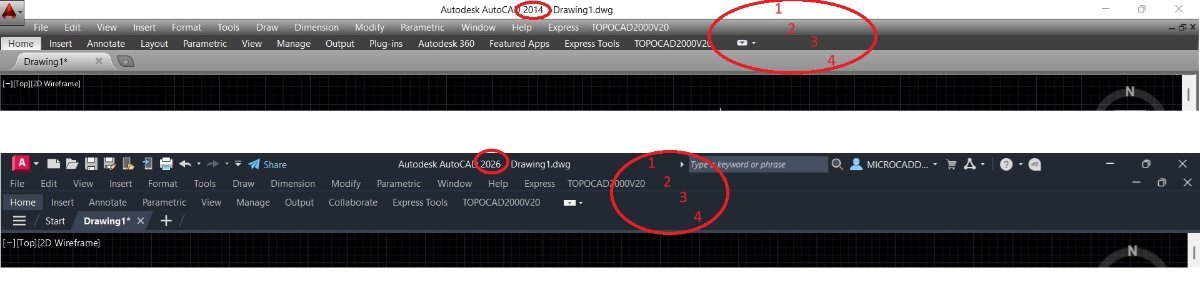
Colors of the top menu bars
FELIXJMELO posted a topic in AutoCAD 2D Drafting, Object Properties & Interface
It is possible to configure the menu bar colors in AutoCAD 2026 to match those of 2014. See the attached image.
-
I also found a new plug-in for QGIS. I will try to put in some home time on this when I can. BecaGIS — QGIS Python Plugins Repository Early on in this thread I posted some links as well. Looking at the work to create these in other CAD/GIS software, it looks like AutoCAD and LISP is the closest to automatic so far, not sure yet how accurate some of the other software and methods can get.
-
FELIXJMELO joined the community
-
Creating river center-lines with WhiteboxTools
-
How can I write the code for a batch fillet plugin for images like this?
SLW210 replied to amook147's topic in AutoLISP, Visual LISP & DCL
Here is the one from Kent Cooper, though it seems suspicious you would be blocked from the Autodesk Forums. This is the one that asks for the radius and will accept 0 radius. ;| FilletMultiplePolylines.lsp [command name: FMP] Asks for desired Fillet radius, offering default of prior value if present, otherwise regular Fillet's value, as default. Asks for selection of Polylines, and Fillets all possible corners at specified radius. Restores regular Fillet's radius setting, but stores setting from this command separately, for default on subsequent use. Works on LightWeight and "heavy" 2D Polylines except those that are Fit- or Spline-curved. Accepts selection of those, and of 3D Polylines, but does not process them. |; ;;; ;;; By Kent Cooper ;;; ;;; Found here https://forums.autodesk.com/t5/visual-lisp-autolisp-and-general/fillet-multiple-polyline-all-at-once-by-lisp/m-p/10151411#M130041 (defun C:FMP ; = Fillet Multiple Polylines (/ *error* doc filr plss n pl) (defun *error* (errmsg) (if (not (wcmatch errmsg "Function cancelled,quit / exit abort,console break")) (princ (strcat "\nError: " errmsg)) ); if (setvar 'filletrad filr); reset (vla-endundomark doc) (princ) ); defun - *error* (vla-startundomark (setq doc (vla-get-activedocument (vlax-get-acad-object)))) (setq filr (getvar 'filletrad)); save current setting (initget 4); no negative (setq *fmpr* ; global variable (cond ( (getdist (strcat "\nRadius for Filleting all Polyline corners <" (rtos (cond (*fmpr*) ((getvar 'filletrad)))) ; prior value as default if present; if not, regular Fillet radius ">: " ); strcat ); getdist ); User-input condition (*fmpr*); prior value if present on Enter ((getvar 'filletrad)); regular Fillet radius if no prior value on Enter ); cond ); setvar (setvar 'filletrad *fmpr*) (if (setq plss (ssget "_:L" '((0 . "*POLYLINE")))) (repeat (setq n (sslength plss)) (setq pl (ssname plss (setq n (1- n)))) (if (= (logand (cdr (assoc 70 (entget pl))) 30) 0); not 3D, fit- or spline-curved (command "_.fillet" "_polyline" pl); then ); if ); repeat ); if (setvar 'filletrad filr) (vla-endundomark doc) (princ) ); defun (vl-load-com) (prompt "\nType FMP to Fillet Multiple Polylines.") -

forcing AutoCAD to look for “AcFields.fdc” in a network location?
halfcracked replied to halfcracked's topic in The CUI, Hatches, Linetypes, Scripts & Macros
it is a pain. that's why I'm trying to find a way to make ACAD use the file in a different location. much like I do for printer configuration files. -

How can I write the code for a batch fillet plugin for images like this?
GLAVCVS replied to amook147's topic in AutoLISP, Visual LISP & DCL
Phew! I just copied and pasted from the link you requested. For some reason, the final parenthesis got lost. But I see that the code suggested here is already more complete. Deprecated! -
forcing AutoCAD to look for “AcFields.fdc” in a network location?
tombu replied to halfcracked's topic in The CUI, Hatches, Linetypes, Scripts & Macros
Sound like the hard way having to update it for every user every time a new version is installed that could be overwritten by an AutoCAD update. I use a Slightly modified version of older version of Lee's code https://www.lee-mac.com/areastofield.html you can find at https://www.cadtutor.net/forum/topic/71208-area-lisp-help/#elControls_571948_menu that labels with selected area or lengths units included. I added the scaled versions of "sqft" for labeling X-Section areas which usually have exaggerated vertical scale for an engineer who wanted it. Tremendous amount of functions in a custom CUI with all code in a network Trusted Support folder. -

How can I write the code for a batch fillet plugin for images like this?
Nikon replied to amook147's topic in AutoLISP, Visual LISP & DCL
The code can connect several polylines with a radius of 0. I understood that FILLETRAD must be set beforehand. Or do this: (defun C:FMP0 ; = Fillet Multiple Polylines (/ plss n) (setvar "FILLETRAD" 0) (if (setq plss (ssget '((0 . "LWPOLYLINE")))) (repeat (setq n (sslength plss)) (command "_.fillet" "_polyline" (ssname plss (setq n (1- n)))) ); repeat ); if (princ) ); defun Or a different code for different radii, and you can also use 0. (defun C:FMP01 (/ rad plss n) (setq rad (getreal " Enter the fillet radius (you can use 0): ")) (setvar "FILLETRAD" rad) (if (setq plss (ssget '((0 . "LWPOLYLINE")))) (repeat (setq n (sslength plss)) (command "_.fillet" "_polyline" (ssname plss (setq n (1- n)))) ) ) (princ) ) -
How can I write the code for a batch fillet plugin for images like this?
Nikon replied to amook147's topic in AutoLISP, Visual LISP & DCL
This code should perform the pairing (without specifying the radius?). The code doesn't work: unknown command. The parenthesis after (princ) is lost. +) -
How can I write the code for a batch fillet plugin for images like this?
GLAVCVS replied to amook147's topic in AutoLISP, Visual LISP & DCL
(defun C:FMP (/ plss n) (if (setq plss (ssget '((0 . "LWPOLYLINE")))) (repeat (setq n (sslength plss)) (command "_.fillet" "_polyline" (ssname plss (setq n (1- n)))) ); repeat ); if (princ) I guess this is it