All Activity
- Past hour
-

GitHub vs APPLOAD: Why is our global impact invisible?
Steven P replied to VicoWang's topic in AutoLISP, Visual LISP & DCL
? Suggests another profile, sign in, password to manage. So for my simple understanding, it is a fancy DCL popup that links to the company or online file store?
-
I've been testing the same DWG files across different CAD applications and comparing how they handle layers, blocks, dimensions and XREFs. One interesting thing I've noticed is that DWG compatibility isn't just about opening the file—it also matters how accurately the drawing behaves when edited and saved. Has anyone here compared different DWG-compatible CAD applications on the same project files? "ACTCAD was one of the applications I tested." , and so far it has handled my DWG files quite well, including layers, blocks and XREFs. I’d be interested to hear if others have had similar or different experiences with ACTCAD or other DWG-compatible CAD software.
- Today
-

GitHub vs APPLOAD: Why is our global impact invisible?
VicoWang replied to VicoWang's topic in AutoLISP, Visual LISP & DCL
Hi Steven, Those are incredibly valid points, and they highlight exactly why we built VedaCAD the way we did. You perfectly described the classic "Enterprise IT Roadblock." To clear up the confusion, VedaCAD is absolutely not a cloud drive (like Dropbox) where you copy and paste files. It is an infrastructure that pipes routines directly into the CAD environment. Let me address your concerns directly, because reducing deployment friction is actually our core design philosophy: 1. No new passwords to remember. We hate account fatigue as much as you do. VedaCAD operates entirely password-less. You either use one-click OAuth (Google, Microsoft, Autodesk) or a secure Magic Link sent to your email. Enterprise(CORP) users log in directly using SSO(OIDC), and there is no password field stored in our system. 2. Zero-Install Footprint (Reducing Deployment Friction). This is the most important part. There is no .exe or .msi installer, and it does not require Windows Administrator rights. The entire VedaCAD client is just a single 1.6MB pure LISP (.vlx) file. It operates completely within the standard bounds of AutoCAD. We strictly manage a secure local sandbox inside the user's directory (%APPDATA%)—there is no Windows Registry injection, no background Windows services, and zero OS-level modifications. If your IT department currently allows you to type APPLOAD for normal LISP routines, VedaCAD complies perfectly with those existing security rules. It is designed to save IT from deployment headaches, not to subvert them. 3. Multi-Platform Roadmap. You asked about BricsCAD. Currently, VedaCAD is strictly built for AutoCAD. We intentionally engineered the entire client inside the native AutoCAD 2006 Visual LISP IDE to guarantee absolute backward compatibility. However, because we built it on pure foundational LISP rather than version-specific .NET frameworks, the workload to port it to other platforms is minimal. We are currently laser-focused on perfecting the commercial loop within the AutoCAD ecosystem, but supporting all 4 major platforms (AutoCAD, BricsCAD, ZWCAD, GstarCAD) is definitively on our roadmap. Basically, we built this specifically so engineering teams can seamlessly sync their setups without creating an IT deployment nightmare. Does that help clarify the workflow? --- Since you specifically brought up how IT folks assess suitability, security, and licensing, I should add a quick high-level overview of how VedaCAD actually handles corporate deployments under the hood. Beyond the personal tier, our Enterprise architecture is fundamentally divided into two major workflows: Internal Fleet Management and External Supply-Chain Control. 1. Internal Fleet Management (The Foundry & Squads) Instead of emailing ZIP files to employees, CAD Managers upload their standard plugins and configurations into a web-based "Enterprise Foundry." (All uploads of the company's plugins and environment configuration files must be uploaded from the company (CAD Manager)administrator's client.) From there, admins create internal Squads (e.g., Architecture, Structural) and assign specific toolsets to each group. When an employee logs in, the VedaCAD client silently deploys only their authorized tools into their local sandbox. Zero Fragmentation: IT can monitor the "Out of Sync" status of any terminal globally from the dashboard. Visual SOPs: Admins can attach Markdown manuals and Demo GIFs to assets. Employees simply click the "SOPs" button inside their CAD client, which uses a secure hardware token to instantly log them into their Web Portal to view the exact workflow guidelines for their assigned tools. 2. External Sub-Contractor Control (Project Arks) This is the killer feature for General Contractors (GCs). Enforcing drafting standards across external vendors is a nightmare. Instead of sending CAD standards via email, GCs create a "Project Ark" and issue time-limited, "Visas" to external sub-contractors. Format Firewall: Arks strictly permit only environment configuration files (.CTB, .DWT, .SHX, etc.). Executable plugins (.DLL, .LSP) are physically blocked to prevent cross-company malware infections. Zero-Trust Shredding: When a sub-contractor mounts the Visa, their CAD environment temporarily mirrors the GC's standards. If the Visa expires or is revoked by the GC, the VedaCAD kernel physically shreds those proprietary standards from the sub-contractor's local hard drive. 3. IT Compliance & Data Sovereignty (Add-ons: BYOS & EDR) To pass the strict security audits of large institutions, our Enterprise tier supports BYOS (Bring Your Own Storage). You can route 100% of your physical CAD assets directly to your company's private AWS S3 bucket—we never touch your binaries. We also offer native EDR Gateway integration, allowing your corporate SecOps sandbox to automatically intercept and quarantine any unverified payloads before they reach the draftsperson's machine. In short, it’s designed to give IT absolute control over data sovereignty and access, while giving CAD Managers a frictionless way to enforce standards. -
GitHub vs APPLOAD: Why is our global impact invisible?
Steven P replied to VicoWang's topic in AutoLISP, Visual LISP & DCL
I am getting confused now as to the function of your cloud repository - OK I get a file store, we log in if we want (I don't actually care to create myself another internet profile with another unique password to manage, and another online service), upload files, others can copy and paste as required. In a crowded market, it might be the best solution out there, it might not. But then there is some integration into CAD (Just AutoCAD or others such as BricsCAD?). This part I am not sure about. Does this need software installing to manage this, and if so I believe our IT folks will be giving it a thumbs down till they have assessed suitability, its security, licensing agreements, ongoing costs ad so on. -
 bing00118 joined the community
 -
GitHub vs APPLOAD: Why is our global impact invisible?
VicoWang replied to VicoWang's topic in AutoLISP, Visual LISP & DCL
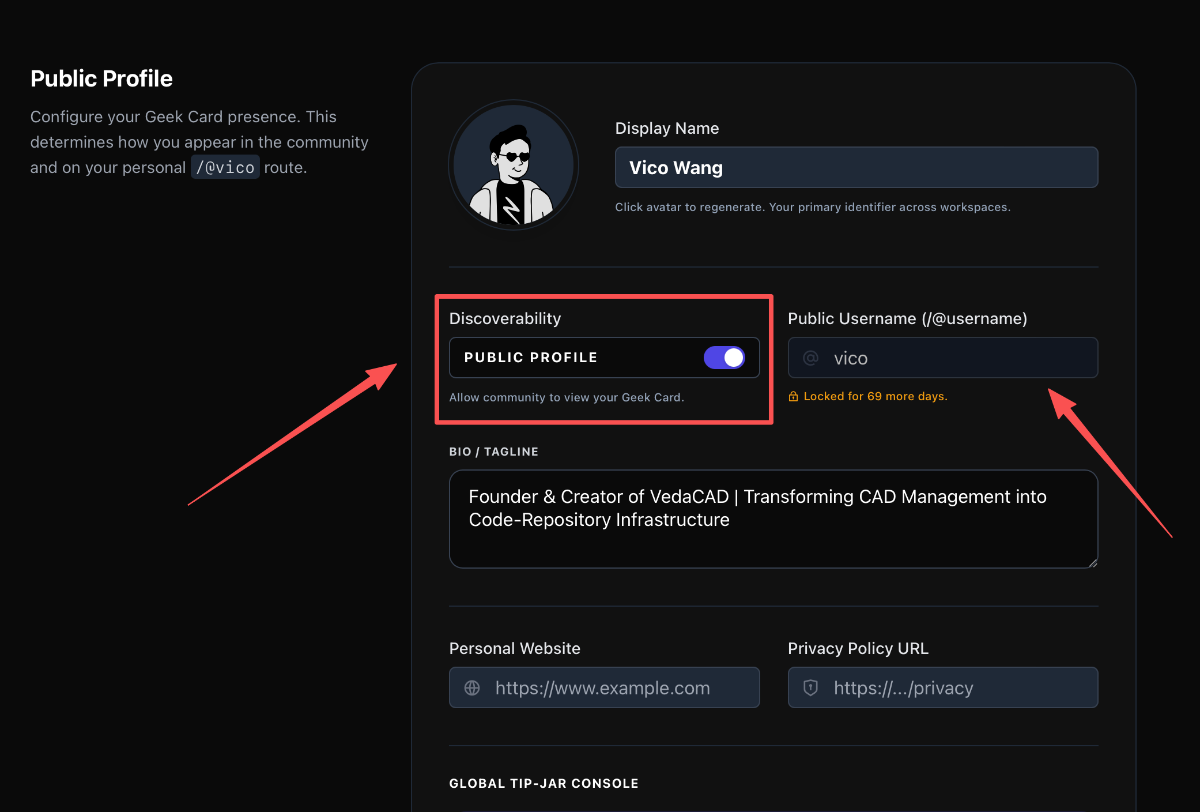
Hi everyone, Just a quick follow-up regarding the Pioneer Index and creator profiles. As the VedaCAD ecosystem is starting to grow, I want to strongly recommend that the veteran developers here—and anyone who has shared tools in the past—take two minutes to claim your @username on the platform. Because VedaCAD operates purely as a neutral conduit, account registration is strictly first-come, first-served. We cannot pre-emptively determine who the "real" owner of a community alias is, nor do we have the authority to evict a user or forcefully reassign a handle once it has been claimed by someone else. Since the platform is still in its early stages, right now is the absolute best window to secure your username sovereignty and prevent impersonation. I want to be absolutely clear: You do not need to upload any scripts or actively use the platform. You can simply register your standard forum alias to lock it down. If you prefer to stay completely off the radar, just log in to the Web Portal, go to Settings > Profile, and toggle off "Public Profile". Your @username will be permanently secured to your email, but you will remain 100% invisible on the Pioneer leaderboard and public directories. I just want to make sure the true creators in this community own their rightful identities before someone else grabs them. Cheers, Vico
-

fire protection LISP routine for the distribution of sprinklers and fire detectors in fire protection installations
Javier Longa replied to Javier Longa's topic in AutoLISP, Visual LISP & DCL
Thanks for the advice and the routine. The routine might be useful for spacing elements, but my code generates a distribution based on coverage, taking into account various parameters. Regarding Copilot falling short, I agree, although I don't think I'll continue working on this routine with this AI, at least not yet. And I should mention that I've created other routines, also with Copilot, which is the only AI I have available. I'm also the author of many dynamic and parametric blocks related to fire protection systems. As for learning to program, as I said before, I'm 60 years old and I don't have much time left before retirement. I don't see it as being productive. Maybe as a hobby. And yes, I've searched for the topic "AutoCAD Lisp Sprinklers" many times and I've never found anything that seems useful and is offered for free. -
GitHub vs APPLOAD: Why is our global impact invisible?
VicoWang replied to VicoWang's topic in AutoLISP, Visual LISP & DCL
Hi Daniel, Great to see you bringing pip concepts into this. PyRx is an absolute beast of a project, and you are 100% correct—version tracking and dependency resolution are the holy grails of package management. Since AutoLISP lacks native import statements or .toml manifests, we had to engineer a slightly different approach for VedaCAD to achieve that exact same pip reliability. Here is how we handle it under the hood: 1. Version Tracking & Hot-Swapping (The State Machine) Instead of a manual CLI command like PYPIP Update, VedaCAD uses a background state machine. During the client heartbeat, it sends a lightweight dictionary of its local plugins and their current versions to the cloud. The server diffs this against the master database. If a developer has patched a script, the server pushes an assetUpdates beacon back to the client. Depending on the workspace policy, the client either prompts the user visually, or (for Enforced Enterprise modes) it executes a dual-buffer hot-swap in the background—renaming the old locked .vlxto .bak and injecting the new binary seamlessly. 2. Dependency Resolution (The Bundle System) If your LISP routine strictly depends on "LM:ODBX 1.2", you don't want users hunting for it. In VedaCAD, the developer creates a "Bundle" (a VCID starting with B-). You package your main script AND the LM:ODBX dependency together. By leaving the command alias blank for the ODBX file, VedaCAD flags it as a "System Library" , which forces it to pre-load silently at startup. Your main script remains demand-loaded. The end-user simply pulls ONE B- VCID, and the entire dependency tree is resolved locally. While a CLI interface is undeniably cool for developers, we ultimately went with a unified GUI dashboard (Command: VC). We found that CAD Managers deploying tools to 50+ draftsmen needed a visual matrix rather than teaching their team command-line syntax. It's awesome seeing different modern architectures (Python/PIP vs Cloud/LISP) tackling the same legacy CAD headaches! -
GitHub vs APPLOAD: Why is our global impact invisible?
VicoWang replied to VicoWang's topic in AutoLISP, Visual LISP & DCL
I know there are tools out there that try to execute LISP directly from the cloud, but as you implied, that requires a flawless real-time connection. VedaCAD takes the exact opposite approach. Our architecture is fundamentally built around a "Local Sandbox Cache".When you pull a VCID, the physical file is downloaded as-is and vaulted directly onto the engineer's local drive (e.g., %APPDATA%\VedaCAD\...). Here is how the engine handles network drops: When CAD starts, our microkernel checks the configured heartbeat cycle. If it's within the valid cycle, it skips the network request completely. If the cycle has expired, it sends a lightweight ping to the server to check for version updates or MDM policy changes. If an engineer opens their laptop on a construction site with zero Wi-Fi, that heartbeat ping simply times out. The VedaCAD kernel instantly detects the disconnection and silently transitions into Offline Mode. The engineer keeps drafting seamlessly using their locally cached plugins and menus. No lag, no missing commands, and absolutely zero need to manage a separate "Out of office" profile. Once they reconnect, the background heartbeat simply resumes on the next cycle. In short: The VCID is just a delivery protocol. The actual execution is always local! To accommodate extended field work while protecting enterprise IP, we built in specific Offline Grace Periods: BASE Mode: Air-gapped by default. Works indefinitely without any internet. FREE Tier: 3 days of offline grace. PRO Tier: 15 days of offline grace. TEAM / CORP Tiers: Configured by the CAD Manager (Max 30 days). -

GitHub vs APPLOAD: Why is our global impact invisible?
Danielm103 replied to VicoWang's topic in AutoLISP, Visual LISP & DCL
Not for lisp, but one thing cool about PIP, is it tracks versioning. When you upload a package to PyPi, your package should include a README.MD and a PROJECT.TOML. the toml might look like. requires-python = ">=3.14.0,<3.15.0" dependencies = [ "wxPython>=4.3.1,<4.4", "pywin32; sys_platform == 'win32'", "debugpy>=1.8.0", "pydantic_settings", ] PIP keeps track of every detail for every project and notifies of potential conflicts. Also, it will install dependencies, I.e. Python for AutoCAD requires wxPython, the system will download the modules for you, and also any dependencies wxPython requires. For lisp, something like this would be valuable. dependencies = [ “LM:ODBX 1.2” ... ] Then, have a command in AutoCAD to help manage I.e. Command: PYPIP [List/Install/Remove/Update] <list>: Package Version Editable project location ----------------- ---------------- ------------------------- annotated-types 0.8.0 appdirs 1.4.4 ast_serialize 0.6.0 asttokens 3.0.2 build 1.5.0 cad-pyrx 3.1.6.5712 M:\Dev\Projects\PyRxGit cfgv 3.5.0 click 8.4.2 colorama 0.4.6 debugpy 1.8.21 all of the packages could be streamed into a .bundle for auto loading -

fire protection LISP routine for the distribution of sprinklers and fire detectors in fire protection installations
BIGAL replied to Javier Longa's topic in AutoLISP, Visual LISP & DCL
In the multi getvals.lsp you can preset a value for say the spacing, or even have 2 values for row & column Min max preset. Just add more to the dcl example. Look at the last "1" change it to say '2.4", it must be a string not a number. That way you can come up with a spacing that meets min max criteria. (if (not AH:getvalsm)(load "Multi Getvals.lsp")) (setq ans (AH:getvalsm (list "Enter values " "Row spacing " 5 4 "2.4" "Col spacing " 5 4 "2.4" ))) Multi GETVALS.lsp In the code it uses the lower left as control, but you can find closest vertice to where you picked the pline outline. Then you can set the control of where the spacing starts from. I use a over draft to cover the entire area with sprinklers then erase those out side of the boundary. Even worked for plines with curves.. I think you will struggle with Copilot as you get more complex with extra features, now is a good time to learn programming. Reading code and getting an understanding of what it is doing and you will soon write your own. Plenty out there to help. Lastly did you google Fire sprinklers autocad lisp" ? The topic has been answered before answers may be at "Forums/Autodesk" aka Autocad. - Yesterday
-
GitHub vs APPLOAD: Why is our global impact invisible?
BIGAL replied to VicoWang's topic in AutoLISP, Visual LISP & DCL
Just a question we had laptops that were used outside no internet access, we had two CAD Icons so they would start the correct profile for "in office" and "out of office", how would your system cope with that ? Would the second profile go looking for the VCID ? -
fire protection LISP routine for the distribution of sprinklers and fire detectors in fire protection installations
Javier Longa replied to Javier Longa's topic in AutoLISP, Visual LISP & DCL
I appreciate those suggestions, of course, but due to my age and the demands of my job, I find it very difficult to learn any kind of programming. I'll continue using Copilot. Regarding what you mentioned @SLW210 about the regulatory values, I don't see any reason to change them. When I created the routine, it was to help my colleagues who are familiar with the values they need to apply, not in a fixed way, but by verifying their validity against the applicable standard. I didn't create the routine for someone unfamiliar with the different fire safety regulations. I've uploaded this application, and I'm repeating myself a lot, sorry, because I don't think I could find anything similar already created by others that was free, and even the existing ones, including those in calculation software, aren't reliable. I also wanted to ask a programming expert to take up the challenge and collaborate on improving it. Following up on this last comment, I'm going to upload a new version that corrects the design when there's a rotation in the UCS, modifies the polyline selection code using Lee Mac's code (thanks to @BIGAL and @Lee Mac), and also includes other considerations. Please excuse me if it's still in Spanish, but as I said, it's primarily for my team's use. PCI_PRO (PFP)_V3_8.lsp -

fire protection LISP routine for the distribution of sprinklers and fire detectors in fire protection installations
SLW210 replied to Javier Longa's topic in AutoLISP, Visual LISP & DCL
Just trying to help you improve your LISP programming, so don't take this as not appreciating what you have done. These suggestions just make it better for everyone and should be doable upgrades, IMO. I would have to know those values in advance. I am sure some people do this everyday and may memorize them, but that is a bad habit to get into. 1. The specifications can change. 2. Some may need to use different standards each project. 3. Some people might mis-remember the values, etc. leading to errors. Programs that deal with a Standard should always employ the standard if possible, even if you make it just for the one you use. For example: Al's Steel Mill and Wisey's, they each employ a different standard for steel shapes and do so with easily updateable files. Here is a thread here on Al's with an updated standards file. Updated AISC Shapes for STL.LSP - AutoLISP, Visual LISP & DCL - AutoCAD Forums There is on CADTutor and maybe some other fora, etc. some programs dealing with piping, they each work towards the respective standards in those industries. ANSI B16.5 Flanges Lisp - AutoLISP, Visual LISP & DCL - AutoCAD Forums There are a few more, but speaking of those flanges, etc. I or someone needs to see if any of those standards have changed since it's been a while. Also, another question, since I rarely have to do sprinklers, etc. that often, does this work with AutoCAD MEP's sprinklers? I'll have to check, but I do not believe they are actual blocks, so that could be another upgrade suggestion. -
GitHub vs APPLOAD: Why is our global impact invisible?
VicoWang replied to VicoWang's topic in AutoLISP, Visual LISP & DCL
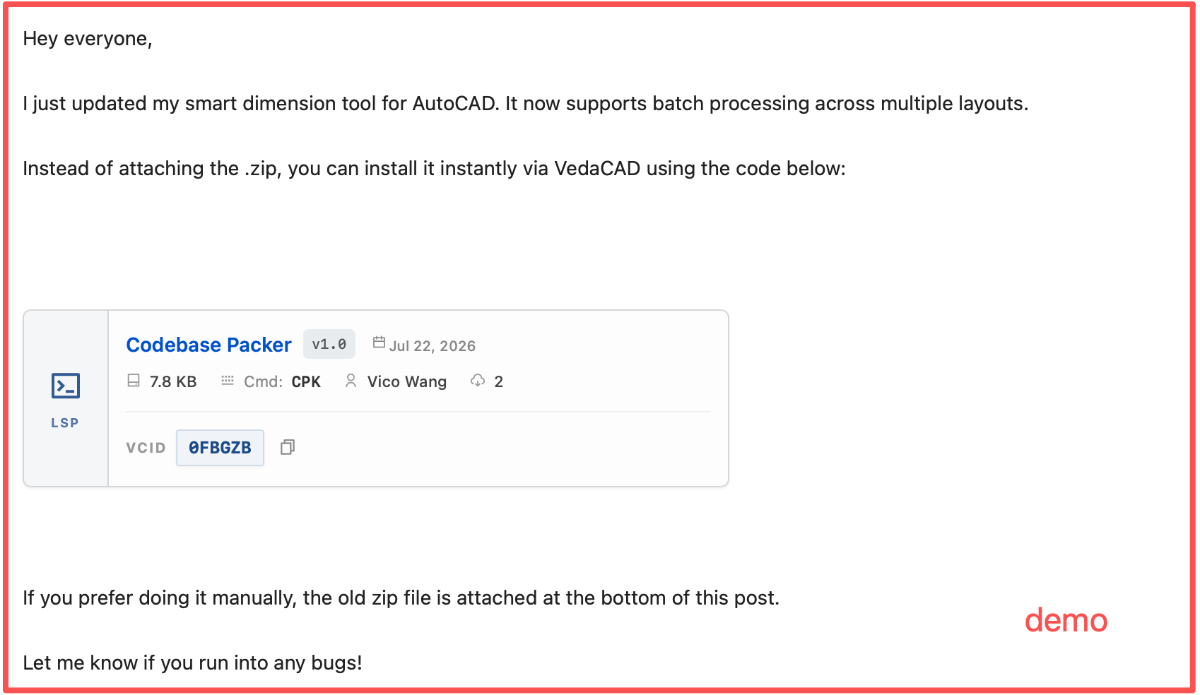
Hi indiancad, Spot on. GitHub is fantastic for version control, but it lacks a delivery bridge to the CAD environment. In modern software engineering, people use pip install. In CAD, we still rely on the archaic APPLOAD and ZIP extraction. VedaCAD is exactly that missing native package manager. Here is a short clip demonstrating our core concept(Install via VCID and run directly): Instead of the painful APPLOAD grind, you just use a 6-character VCID. Even better, it makes migrating to a new PC completely painless. The system pulls the binary into a local sandbox and maps it instantly. Where this truly changes the game is Fleet Deployment. IT admins no longer need to manually configure 50 different workstations. By pushing enterprise VCID clusters, every terminal instantly achieves absolute consistency, while automatically delivering targeted toolsets based on the employee's squad (e.g., Architecture vs. Structural teams)—all without anyone ever touching a "Support Path". GitHub for the source code + VedaCAD for deployment is definitely the perfect modern combo. Might be worth giving it a spin! -
Removal of Wipeouts from nested and anonymous nested blocks
SLW210 replied to Hsanon's topic in AutoLISP, Visual LISP & DCL
Did you check if anything in this thread helps? Delete all Wipeouts within a Drawing including Blocks - Page 2 - AutoLISP, Visual LISP & DCL - AutoCAD Forums Are they actually Wipeouts or could some be text masks, dimension background masks, Hatches, etc.? Could you post an example drawing of exactly what objects you need removed? When I get time, I'll try a shot at what you have already, but an example drawing would help a lot as I don't use Wipeouts a whole lot.- 1 reply
-
- 1
-

-
.thumb.jpg.615654602253be56b2fbd5d064834780.jpg)
GitHub vs APPLOAD: Why is our global impact invisible?
indiancad replied to VicoWang's topic in AutoLISP, Visual LISP & DCL
From my experience, GitHub and APPLOAD really serve two different purposes. I usually keep my LISP routines on GitHub so I can access and update them easily. But when I'm actually working in CAD, APPLOAD is still the quickest way to test a routine. For frequently used routines, I add them to the Startup Suite so they load automatically. The problem is that a useful LISP can sit on GitHub and still be almost invisible to CAD users. People usually discover routines through forums, recommendations, or someone sharing the code. Good documentation and simple examples make a huge difference in whether people actually use them. I think GitHub is excellent for maintaining the code and tracking improvements. CAD forums are still important for getting that code in front of people who need it. Ideally, I'd use GitHub for distribution and version control, and APPLOAD for everyday use. -
GitHub vs APPLOAD: Why is our global impact invisible?
VicoWang replied to VicoWang's topic in AutoLISP, Visual LISP & DCL
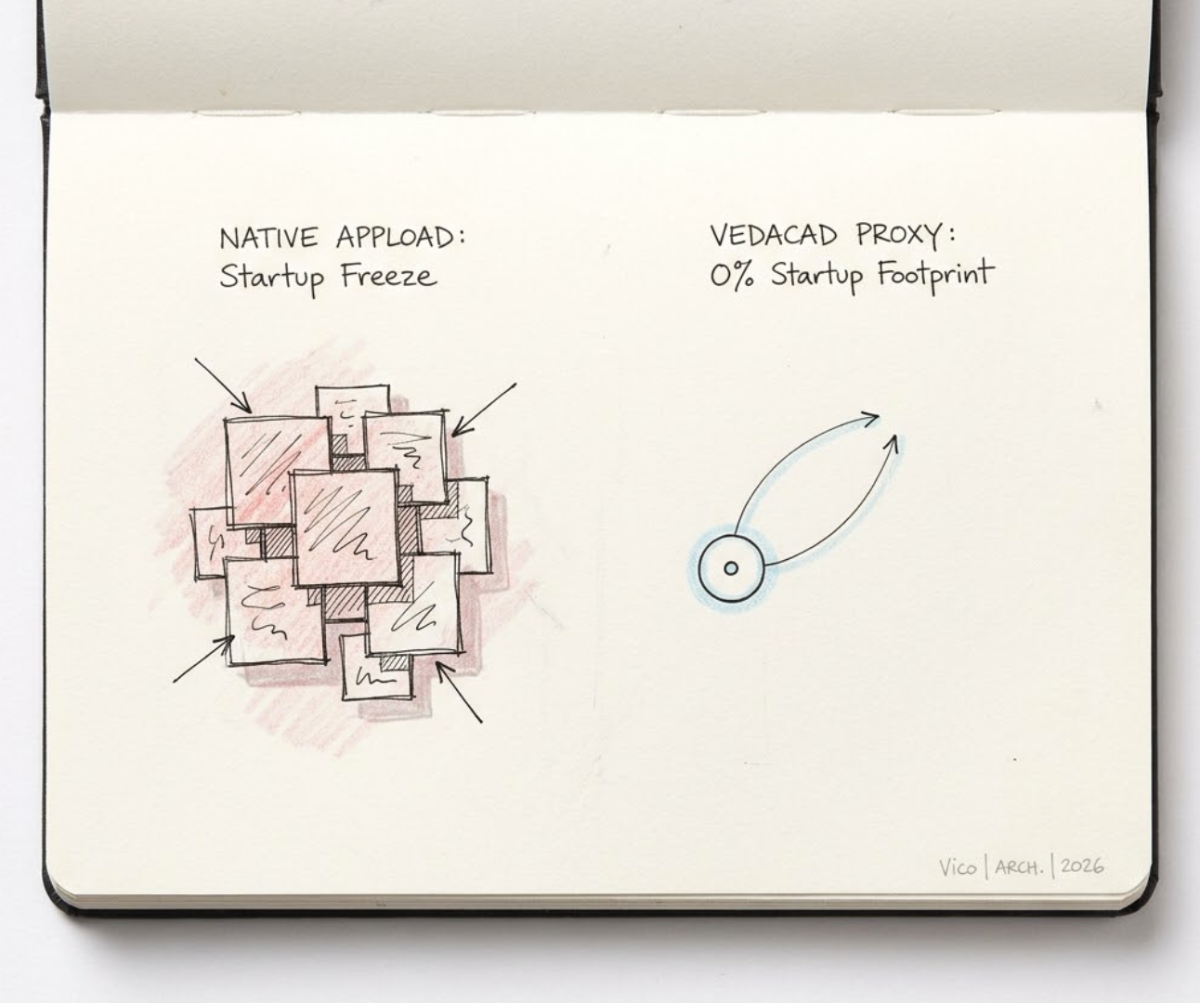
Spot on. VedaCAD actually uses the exact same demand-load philosophy to keep startup memory at 0%.The fundamental difference isn't memory management, it's Routing.Native AUTOLOAD relies on AutoCAD's Support Search Paths to locate the physical file. If an IT admin or user alters the Support Paths, the command dies silently. VedaCAD uses an independent Mapping Database. It binds your custom alias directly to the absolute physical file, completely bypassing AutoCAD's Support Paths. It eliminates path configurations forever, making multi-device migrations mathematically frictionless.Especially when you deploy a plugin via VCID—everything executes within an isolated local sandbox cache, rendering traditional search paths completely obsolete. Basically, just a modern UI mapping wrapper over a brilliant classic concept. -
GitHub vs APPLOAD: Why is our global impact invisible?
BIGAL replied to VicoWang's topic in AutoLISP, Visual LISP & DCL
I think your overlooking the AUTOLOAD function, yes in my Autoload.lsp loads on startup there are 37 defuns, most are very small like DTR, RTD, then there are 38 Autoload's the way Autoload works is you type a command and a lisp program is loaded, so you limit how many lisps are loaded on startup, In the pop there is (load "myprogram") "nowrunit" so again only loaded when you need the program. (autoload "COPY0" '("COPY0")) (autoload "COPYCOMMAND" '("ZZZ")) (autoload "COVER" '("COVER")) -

Removal of Wipeouts from nested and anonymous nested blocks
Hsanon posted a topic in AutoLISP, Visual LISP & DCL
Hi...... Im trying (using AI too) to make a program to remove wipeouts from selected (or all ) blocks picked from screen.... some are nested blocks, some dynamic blocks exploded... The code does not come out correctly, either it blanket delets all wipeouts in the drawing, or ramdom wipeouts, or.... it doesnt work at all. Im not smart enough to review the VLisp code to identify or fix it... RemWipeout.lsp -
fire protection LISP routine for the distribution of sprinklers and fire detectors in fire protection installations
Javier Longa replied to Javier Longa's topic in AutoLISP, Visual LISP & DCL
I apologize @BIGAL, because I don't think I explained myself well. The code was generated entirely by COPILOT, Microsoft's AI, following the instructions I gave it. If there had been a previous author in this case, I would have mentioned it, just as I've confessed that I'm a huge fan of @Lee Mac's work. And I don't think I made it clear that if any member of this group, expert or not, feels like improving this code, I'll be very grateful, as it's code that could be very useful in my profession. I'll try to add the necessary code to account for the UCS rotation (Array if a new UCS OB). Replying to @SLW210, I think the simplicity of the code lies in the fact that it can use NFPA values as well as FM Global or UNE EN 12845 values, since it only requires adding distances. -
 İRKOVİC joined the community
 -
GitHub vs APPLOAD: Why is our global impact invisible?
VicoWang replied to VicoWang's topic in AutoLISP, Visual LISP & DCL
Wow, BIGAL. That is an absolute masterpiece of CAD engineering. When I mentioned Lee Mac’s hundreds of plugins, I knew it was just the tip of the iceberg. Your 3,000+ LISP repository, driven by a massive custom CUI drop-down menu, is exactly the kind of industrial-scale ecosystem I was talking about. Since this thread is focused on our FREE tier and community tools, I’ll share how VedaCAD handles this massive volume natively: The very core of VedaCAD is built on a completely decoupled "Demand-Loading Proxy" architecture. Even for free users, loading 130 scripts into the manager won't freeze AutoCAD at startup. The microkernel only registers lightweight proxy hooks in memory. For the UI, the system automatically generates a clean, paginated visual matrix to manage and trigger them, acting as a menu panel out-of-the-box. However, I know veterans want to keep their beloved, highly-customized .cuix interfaces. That's where our PRO tier integration comes in. Traditionally, migrating a .cuix file means manually fixing Support Paths and APPLOADing all those scripts. In VedaCAD PRO, the system natively supports environment files. It silently mounts your CUIX via _.MENULOAD. Because the core proxy hooks are already sitting in memory, when you click your drop-down menu, the proxy catches it and lazy-loads the actual binary in milliseconds. Hit "Cloud Config Sync", go to a new PC, and your entire top ribbon and 130 scripts are wired up in seconds. Scaled up to the Enterprise tier, an IT Admin can mount this exact setup into a central Foundry and deploy it silently to hundreds of employee terminals simultaneously. Managing 3000+ files manually is a monumental task. Massive respect for keeping that running smoothly for decades! -- Additionally, I would like to ask how you manage the versions of each plugin for such a large number of Lisp?
- Last week
-
GitHub vs APPLOAD: Why is our global impact invisible?
BIGAL replied to VicoWang's topic in AutoLISP, Visual LISP & DCL
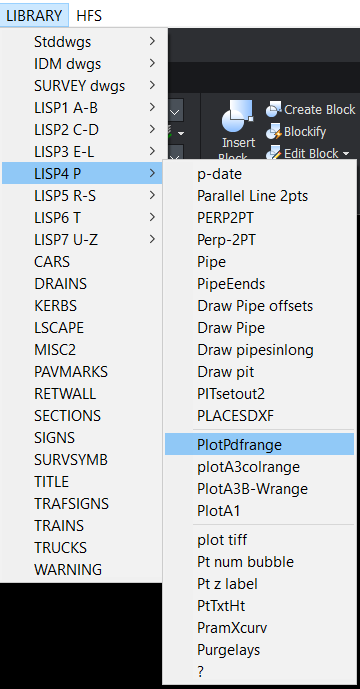
I am sure if you ask some one will beat this number I have 3000+ lisps, some are client lisps some are forum, some are a package, some downloaded for future reference. This has 130 lisps behind it. Just one of 3 pop menu's. This is a package
-
 Nytrux joined the community
 -
 qaisar imtiaz joined the community
 -
GitHub vs APPLOAD: Why is our global impact invisible?
VicoWang replied to VicoWang's topic in AutoLISP, Visual LISP & DCL
I very much agree with you that the forum form is an optimal mode of non-immediate and efficient knowledge precipitation (and the best way to reach through search at any time), but it is inevitably fragmented. The solution I provide is not to replace the function of the forum, but to collect everyone's achievements and count them independently. It is just an optional element in the forum flow, such as a card. In my ideal framework, it should run like this: 1. You (the developer) publish plug-in promotion posts or reply to other people's posts to provide solutions. You describe your algorithm, ideas or solution code in words, and provide such as [VCID]123ABC[/VCID] to attach your plug-in (as optional). Of course, you can also mention The source code or LSP file is available for you to download. You can completely publish it in LSP format for open source. 2. Whenever anyone finds the plan you left at that time in any way, they can download LSP or directly use VCID to download your plug-in to obtain the knowledge crystallization you selflessly share. 3. Difference: If you use the source code or attachment, if you want to update your plug-in in the future, you must find the original location, and then update the latest version, such as 1.1; if you use VCID, even after 10 years, others will use the you left at the beginning VCID download plug-ins can be downloaded to the latest version, such as version 1.2 (you updated it 3 years ago and did not notify any users). 4. Through the VCID protocol, version fragmentation is eliminated, and importantly, anything downloaded through VCID will be collected to vedacad.com/pioneers and the total number will be calculated and ranked. More importantly, our original distribution logic ensures the signature at the time of publication. Anyone who downloads is the original version provided by you, not the secondary modified version of Vico on the basis of Steven P 1.0 (we all know that the original author's signature may be omitted in this process) . It's a pleasure to discuss with you. --- The arrival of AI is inevitable, and the market prospects you describe are highly likely to come true. This is also the reason why I want veterans to VCID their achievements, because for the same demand, would you use someone's XXX (VIA AI) or the veterans' XXX? It's an obvious thing, because any software, besides what it can do, also includes the long-tail value that the people behind it can provide. What do you think?
-
LISP: Find & Replace Without the Lag of AutoCAD's Default Command
Steven P replied to CamDuy's topic in AutoLISP, Visual LISP & DCL
I've used this for years: https://forums.autodesk.com/t5/visual-lisp-autolisp-and-general/find-and-replace-text/td-p/5649883 and some discussion here: https://www.cadtutor.net/forum/topic/92643-batch-find-and-replace/ Noting that the slowest part of any LISP is usually the user interfacing with the software, Looks a nice interface. Without the dialogues of course, you can gain an efficiency with batching a series of drawings -
GitHub vs APPLOAD: Why is our global impact invisible?
Steven P replied to VicoWang's topic in AutoLISP, Visual LISP & DCL
Whatever store there is on the internet will suffer similarly from Al generated code, a store where code is uploaded quickly will just become very large, lose its value when there are too many resources to choose all doing something very similar. I think I prefer the forum format (probably always will do), that in creating an answer to the problems asked there is some peer review going on, explanation as what does what and the ability to ask for explanations or how to modify a code supplied to a more unique solution - which is all in itself a great learnign tool