
Leaderboard



Popular Content
Showing content with the highest reputation since 09/28/2025 in Files
-
1,167 downloads
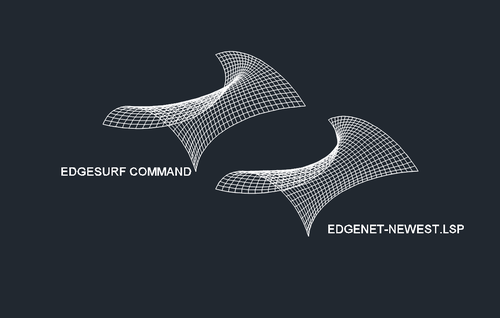
;-------------------------------------------------; ; EDGENET ROUTINE - TWIN OF COMMAND EDGESURF ; ;-------------------------------------------------; ; Author : Marko Ribar, d.i.a. (architect) ; ; Copyright (C) - All rights reserved, 11.2019. ; ;-------------------------------------------------; ; You have permission to copy any part of code ; ; with guarantee that this header will be ; ; present in material that is modified or ; ; partly remained the same as in this routine ; ; version. If header is removed, you are ; ; responsible to mention author and link from ; ; where the code is publiced with explicit ; ; mark that material is copyrighted and is not ; ; for further distribution or selling or base ; ; for gaining any material or any other benefit ; ; than for learning and study and eventual ; ; improvement of its present functionality. ; ;-------------------------------------------------; edgenet-newest.lsp is routine that works similar to command EDGESURF... The difference between EDGESURF and EDGENET-NEWEST.LSP is that LSP version makes Polygon Mesh that is with softer and smaller magnitude lofting approximation... If you wish you can check several routines packed in ZIP and find the one you prefer... They are little slower than built-in EDGESURF, but nevertheless IMHO they are good examples of how this task can be solved from LISP perspective... As always I am opened for any input and your versions (if you have and willing to share)... Regards, Marko Ribar, d.i.a. (architect)2 points -
Version 1.0.0
61,164 downloads
Here are 16 variants of TSP*.lsp files... First one : TSP.lsp - Wrapper for grid and rnd disposition - LISP and ObjectARX... (VLCE - AutoCAD 2025 & BricsCAD V25) Second one : TSP-ALL.lsp - Gathered plenty of subfunctions to pull out best results by permutations of point clouds... Third one : TSP-cheapestpath.lsp - Similar to TSP.lsp (wrapper) but without choosing for grid and rnd dispositions... (VLCE - AutoCAD 2025 & BricsCAD V25) Fourth one : TSP-MMR.lsp - Fast grid and rnd disposition with Evgeniy Elpanov's optimization with 2 factor permutation... Fifth one : TSP-MR-AROUND-CONCAVE.lsp - Very nice little routine to make stars from radially disposition of points... Sixth one : TSP3D-ACO.lsp - Ant Colony Optimization for Traveling Salesperson Problem for 3d points or picked polyline... Seventh one : TSP3D-FAST.lsp - Simple and fast tsp for 3d points... Eight one : TSP3D-GENETIC-NEW.lsp - Simplified 3d Genetic Algorithm for 3d points or picked polyline... Ninth one : TSP3D-SOLVER.lsp - Small and simple tsp for 3d points... Tenth one : TSP3D-tsptour_lsp-new.lsp - Basic 3d TSP that combines both grid and rnd 3d points dispositions... Eleventh one : TSP3D-tsptour_lsp-new+solver+fast.lsp - Powerful version that combines TSP3D-tsptour_lsp-new, TSP3D-FAST and TSP3D-SOLVER... Twelfth one : TSP-HeldKarp.lsp - HeldKarp algorithm for AutoLISP... Gives shortest result, but for up to 20 3d points... Thirteenth one : TSP-2p+3p_by_2p+3p-car-sort.lsp - Building solution based on bunch of smaller to larger distances between 2 or 3 points... Fourteenth one : TSP-2p+3p_by_2p+3p-HeldKarp-tsptour-grid-car-sort.lsp - Newest lsp that combines powerful subs with tour, grid and 2 or 3 point distances points gatherings - can recognize grid and rnd dispositions automatically... IMHO, the best of both worlds - quick runtime and short path length... Fifteenth one : TSP3D-ARX.lsp - Wrapper for "tsptwooptarx.arx" that is also provided in this collection of files inside this "TSP-7z"... This *.arx is incredibly fast and is meant for usage with big point clouds (1000 and more points), where previous *.lsp files are useless in terms of runtime execution... (This "tsptwooptarx.arx" is compatible with AutoCAD R2022-2024) Sixteenth one : TSP3D-ARX-BRX-HeldKarp-grid-cheapestpath-car-sort.lsp - Wrapper for both "twoopt" and "VLCE"... It's the lastest coded lisp, so it behaves very well for both big, or smaller point clouds... All necessary checkings, for arx, brx files and also checking for rnd / grid points dispositions are hardcoded in this *.lsp wrapper... Big thanks to Daniel from www.theswamp.org for providing *.arx and *.brx files for AutoCAD and BricsCAD... More info and newly added *.arx, *.brx, ... at this link : https://www.theswamp.org/index.php?topic=58049.0 HTH. M.R.1 point -
Version 4.2.28.0
9,785 downloads
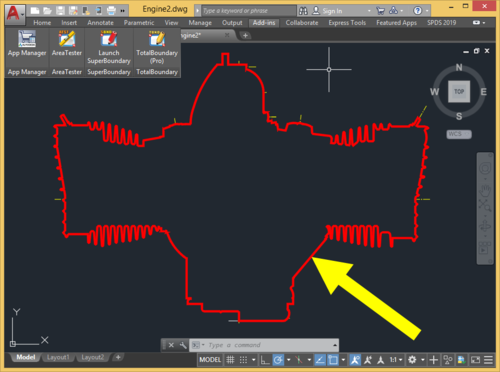
TotalBoundary (Pro) is a professional plugin for generating 2D outline drawings of various degrees of complexity with AutoCAD®. The outline drawings it creates are closed polylines marking the boundaries of various types of objects, which can include elementary entities (lines and arcs) as well as complex blocks and curves (ellipses and splines). What sets the TotalBoundary (Pro) utility apart from AutoCAD's built-in tools (such as BOUNDARY, BPOLY) and from other third-party programs is its high productivity and stability, and also the quality of the outlines it generates. The inbuilt algorithm for detecting spacing (gaps) between neighboring objects allows users to create enclosed outline polylines with exceptional accuracy. The program can process tens of thousands of objects extremely efficiently (in a matter of seconds), flawlessly generating highly complex outline polylines in the selected drawings. Key features: The program's powerful engine allows it to build enclosed polylines rapidly along the perimeter of selected drawing fragments. The original drawing needs no advance preparation (removing superfluous unconnected lines, creating an additional enclosed boundary polyline around the original drawing fragment). When the program creates an outline, it automatically identifies and removes gaps in places where primitives meet. The maximum size of these gaps can be set directly by the user. The program replaces splines and ellipses used in defining an outline with true polylines created by means of piecewise linear approximation. The user can also easily set the thickness and color of the polylines the program generates, if required. The program offers an automatic filling (solid hatching) option for the outlines it generates.1 point -
Version 1.0.1
4,609 downloads
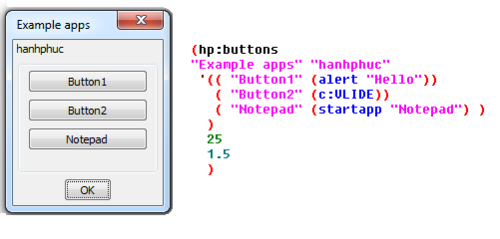
Thank you for supporting this "HP:BUTTONS.lsp" DCL library. This routine allows you to create DCL with multiple buttons associated to DCL action_tile list on the fly. It creates DCL box with single column x nRows of buttons, 'n' depends on the length of the 'action list' usage: (hp:buttons title lst width ht) title = Name caption on top of DCL - string lst = quoted list or progn list - list width = Width of the dialod box - integer ht = height of each button - integer returns nil or any execution (progn ... ) related to action_tile Save this file into your support folder, append to your startup autoload routine. In order to optimize the user experience, it allows maxinum 15 rows however you can abjust depends on screen size. HP:BUTTONS - v1.0 Free LISP by - hanhphuc email: hanhphuc.diy@outlook.com1 point