Leaderboard


Popular Content
Showing content with the highest reputation on 11/13/2025 in all areas
-
I copied another function of dijkstra's algorithm to find the shortest path. It might need a lot of optimization, but just as a proof of concept. centerline voronoi dijkstra.lsp Code I forgot to include: (defun RemoveDuplicatesAux ( x ) (cond ((vl-position x index)) ((null (setq index (cons x index)))) ) ) (defun RemoveDuplicates ( lst / index ) (vl-remove-if 'RemoveDuplicatesAux lst ) )
 4 points
 -
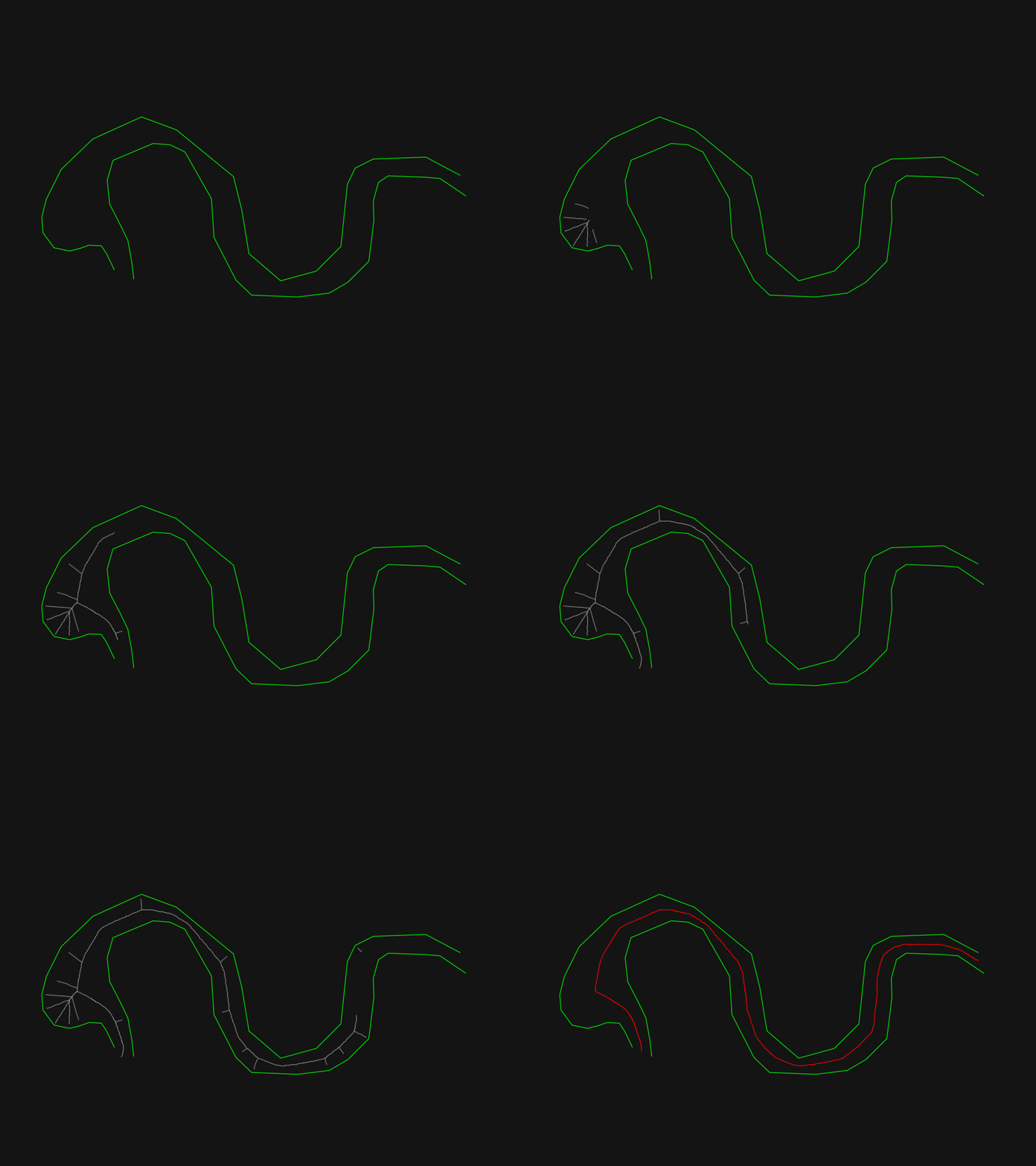
Using a voronoi diagram (code by ymg, ElpanovEvgeniy and Marko Ribar) You can get some very good reference points. Just have to find a way to get rid of all the 'branches' and then take al the midpoints of every line to get a good centerline. centerline-voronoi.lsp
4 points
-
You can limit what ssget selects by entity, layer, color, size, basically anything in dxf codes. please read up on ssget This means you could just make a window selection. And not have to zoom in and out to make selections. also @Steven P already said "ssadd does a check if the entity exists in the set" check the length of SS before and after to see if it was already in the list. also also looks like your not using localized variables could be why its taking so long. (defun C:123 ( / ss pick l) (setq ss (ssadd)) (princ "\nSelect Entity: ") (while (setq pick (ssget)) (foreach ent (vl-remove-if 'listp (mapcar 'cadr (ssnamex pick))) (setq l (sslength ss)) ; Length before adding (setq ss (ssadd ent ss)) ; Try adding entity (if (= l (sslength ss)) ; If length is the same, item was already in list (princ "\n\nDuplicate Selected Line") ) ) (princ (strcat "\n" (itoa (sslength ss)) " Entities now in Selection SS")) ) ; rest of code goes here (princ) ) (defun C:bm ( / ss ent) (while (setq SS (ssget (ssget "_+.:E:S"))) ;exits if selection isn't made (setq ent (ssname ss 0)) ;CODE ) )1 point
-
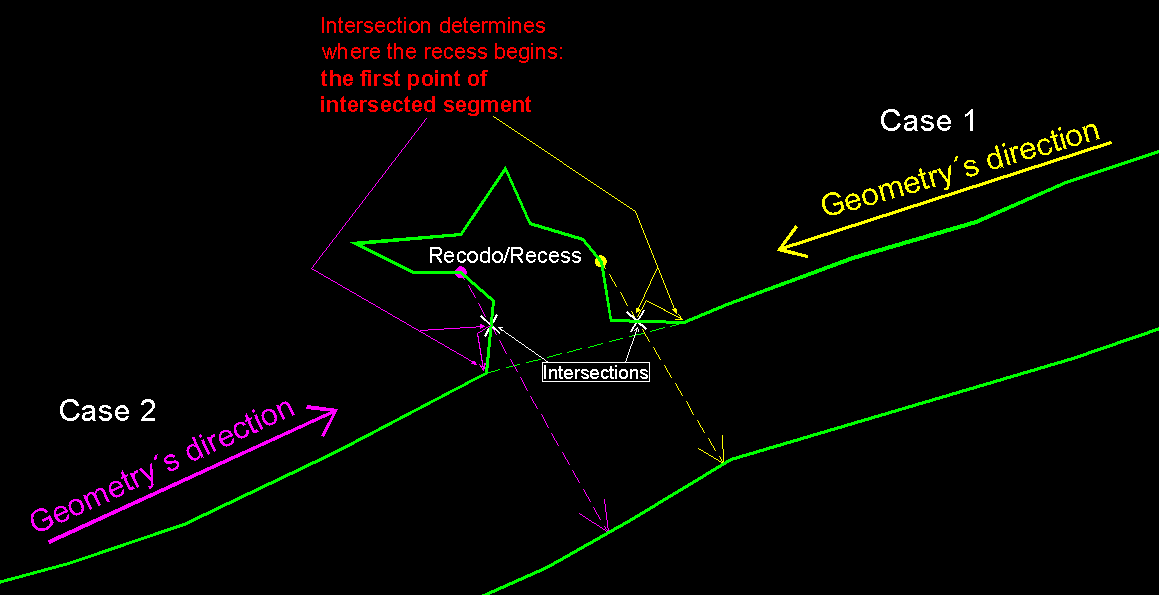
Everything SLW210 has researched is very interesting. I had no idea this had been such a thoroughly discussed topic — and with such limited success. I guess that makes it even more interesting. In my opinion, it is possible to obtain a center polyline that is equidistant from both edges. But two conditions must be met: 1. The user must ensure that the geometry of both edges is correct: they must be 2D polylines with no repeated points and no geometric inconsistencies of any kind. And, in principle, to avoid extending the search for a solution, these polylines should not contain arcs. 2. One must accept that any edge containing “recesses” (“recodos”) must be handled using auxiliary axes. What is a recess? It is a geometric setback, in any direction, along one of the edges. For example: if you advance segment by segment along an edge (in either direction), the start of a recess would be defined as any vertex from which the shortest distance to the opposite edge forces the projection to intersect its own edge. My conclusion: for edges without recesses, I believe it is possible to find an equidistant centerline or axis. And for edges with recesses, although considerably more code will be needed, they should be solvable using auxiliary axes. I hope to have code soon that supports all of this.
1 point
-
I think ronjonp posted something that if you clicked two points on a polyline it would find the shortest path. (traveling salesman) The method I was working on but haven't finished. two open polylines find start and end points of each test how they are oriented and revers one to use to make a closed polyline find the longest distance between the two original polyline divide that by like 500 and offset in using entlast and eventually will end (cant offset anymore) find the polyline with the lowest area but still has the same amount of vertex as the original boundary. using that smaller boundary to draw vector lines between smallest and original boundary. (where im at now) take all other polylines inside smallest and add them to a point list. remove any points that are Collinear with any of the drawn vector lines. this should leave only the points on the center line. starting at one end need to start group points that are Collinear to each other. of those points entmake a line on the farthest distance. these lines are incomplete segments or might not be touching and will need to be extended to each other or the vector lines or both. problem i am finding/trying to solve what slw210 pointed out about if two segments are close to being parallel points wont be found. need three points to calculate collinear working over a group of points to split out each segment.1 point
-
Have a progress output to the bottom left for long process is always a good idea because people will cancel commands that they think are hung. https://www.cadtutor.net/forum/topic/75702-all-objects-inside-this-selection-want-to-send-layer-0/#findComment-598604 in the update loop if user hits esc exit lisp1 point
-
Case 2: This nicest user friendly way I found.. is not the nicest user friendly way in programming - involves grread which the help suggests is rarely needed and for advanced users.... grread if the input is keyboard or mouse input. If keyboard check if it is enter, X, space or escape (enter, space, escape got to use character codes) else ignore text inputs. If mouse input check if they have selected an object or just clicking empty space However the help suggests doing this in other ways. For both cases, and MHUPPs question what is the goal you are wanting to achieve.1 point
-
Case 1: ssadd does a check if the entity exists in the set, you can change CASE 1 (setq ss (ssadd)) (if (not (ssmemb n ss)) (ssadd n ss) ;code );if to CASE 1 (ssadd n ss) ;code Often in code optimisation is rarely a single line that makes a difference... unless you are doing thousands of calculations, so here taking out an if statement won't do a lot. Most likely you have a loop within a loop that slows things - might be more efficient to look back at how you are selecting the entities and processing them before adding to the selection set. However don't just accept that, if you code will work without the line take out your if statement, and ssadd and you shouldn't really notice a big difference in speed1 point
-
Apparently, it’s a difficult task, people write papers on them https://ieeexplore.ieee.org/stamp/stamp.jsp?arnumber=86254161 point