All Activity
- Past hour
-

TurboPlot v1.1: Standalone, Multi-threaded Batch Plotter (Auto-detects Frames!)
vudungcom posted a topic in Application Beta Testing
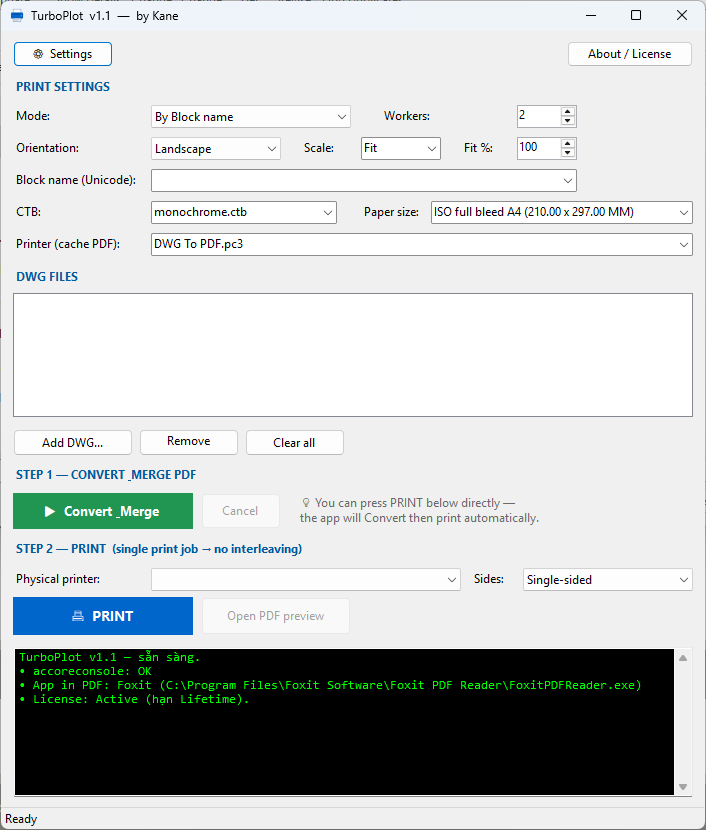
Hi everyone, If you are dealing with hundreds of DWG files daily, you probably know the pain of traditional batch plotting tools: AutoCAD freezes up, memory leaks cause crashes, and worst of all—because it plots so slowly, other people's print jobs often get mixed into your batch on the shared office printer! I’ve developed a standalone software called TurboPlot (v1.1) to solve this exact nightmare, especially when you are on a tight deadline and need your drawings printed instantly. Unlike standard LISP or .NET add-ins that use the slow ActiveX/COM interface, TurboPlot runs completely independently outside of AutoCAD. It utilizes a highly optimized background engine with True Multi-threading, meaning it plots your drawings silently at blazing speeds while you continue working on other things. See it in action: I've recorded a short video demonstrating how it works. Check it out here: [Insert your YouTube Link here] Key Features & Problem Solvers: No More Interleaved Print Jobs: TurboPlot compiles all your drawings into one single merged PDF before sending it to your physical printer as ONE continuous print job. Your batch stays perfectly together—nobody else in the office can interrupt your print queue again! Built for Rush Jobs (True Multi-threading): When you need drawings urgently, you can't afford to watch AutoCAD slowly open and close each file. TurboPlot plots 4, 8, or 16 DWGs simultaneously in the background. It gets the job done in a fraction of the time with zero freezing. Smart Frame Auto-Detection (Game Changer!): You don't need to specify a block name anymore! Leave the name field blank, and TurboPlot will automatically scan the Model or Layout, calculate areas, and instantly find the Largest Frames (whether they are Blocks or closed Polylines) to plot. Multiple Plot Modes: By Block Name: Type your title block name(s) (supports multiple names separated by commas) with a history dropdown. By Layout: Auto-detects and plots all frames within your layouts. Model Extents. PDF Management: Automatically merges hundreds of plots into a single neat PDF, OR saves them as individual PDFs next to the original DWG (with _001, _002 suffixes). No NETLOAD Required: It’s a standalone Windows App. Just open it, drag and drop your DWGs, choose your CTB/Paper Size, and hit run. Multilingual UI: English, Spanish, Portuguese, Chinese, Japanese, Korean, and Vietnamese. Why is it faster & more stable? Because it processes your files in the background without loading the heavy AutoCAD GUI, Ribbons, or Workspaces. It silently grabs the exact Bounding Boxes of your frames and plots them flawlessly (with built-in edge-protection margins so your borders never get cut off). If you are interested in testing it out or saving hours of plotting time every week, let me know or drop a comment below! I'd love to hear feedback from the community. https://www.youtube.com/watch?v=O-ZZ53UuKFQ Download link https://drive.google.com/file/d/14Cn911glapa3nTSigD1srU7LKOHjarz5/view
-
Pretty positive I was zoomed out with the 2000i as well, but I'll retest zoomed out, maybe tonight if home time allows.
-
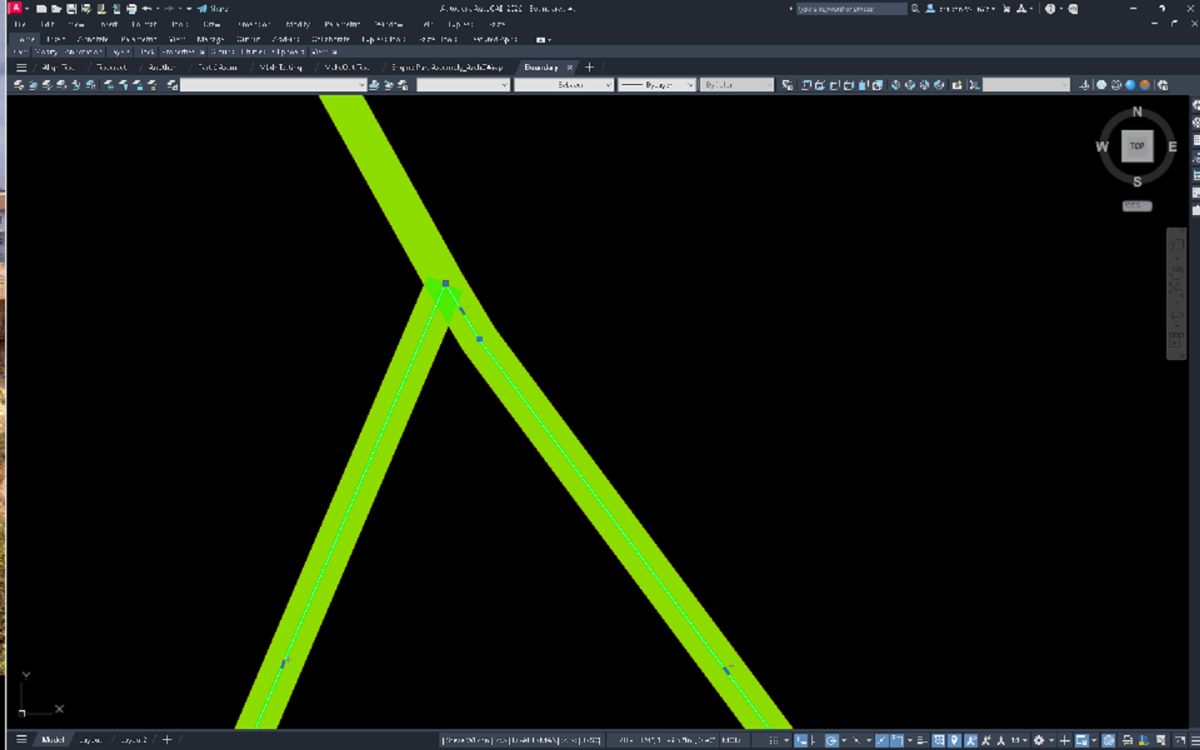
So I tried zoomed in on AutoCAD 2026 and looks to be correct. Boundary.dwg
- Today
-
This has been talked before if I understood the problem correctly: https://www.cadtutor.net/forum/topic/61468-boundary-precision/ To create a boundary you have to have the whole area visible in your model, everything needs to be visible in display area So it has to do something with your "viewing resolution" (zoom), that's how command works. What is the limit I don't know, I never did tests like they did in topic mentioned above. But I also had the same problems with large areas like you posted, when I have one short line, or polyline segment, one of the boundary vertices would be wrong (bad precision). The solution for me was to create lisp working with regions, then convert region to polyline. When creating regions you don't need to see the whole area on your screen, you select the lines and its just pure math from there
-
I use windows terminal winget upgrade. the publisher has to send them the file i think how it works.
-
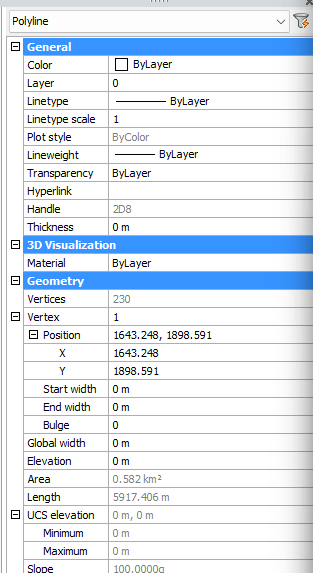
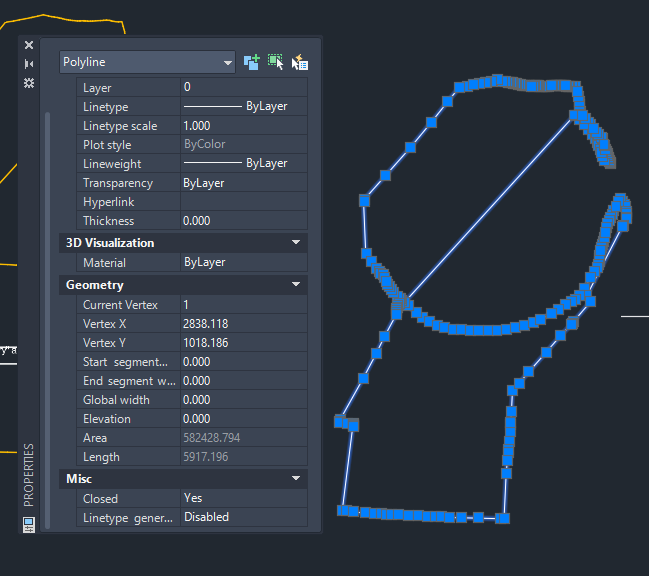
BricsCAD is showing 230 61+119+53 - 3overlapping points.
-
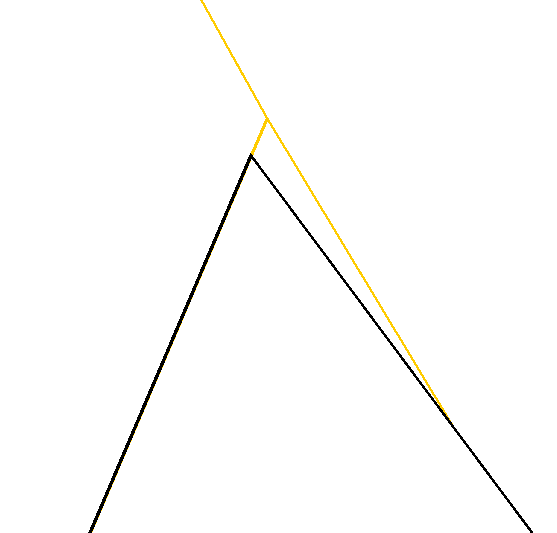
I reversed all the polylines see if that does anything. -Edit Might fix it on the bottom but then mess it up on the top. Rervers Boundary.dwg
-
I exploded the polylines into lines. I also reduced the lineweight to 0, but in both cases the result remains the same. A colleague who still has an old PC with Autodesk Map 5 (= AutoCAD 2002) also confirmed that the same error occurs. If I’m not mistaken, AutoCAD 2002 is basically the same as AutoCAD 2000, so @SLW210’s statement that the "boundary" command works correctly in that version intrigues me.
-
I just upgraded this morning lol! I had seen the warning on hacker news, pretty much using VS code for everything now
- Yesterday
-
@Danielm103, I'm on rev. 8.9.3 so does not apply to me. Thanks for the warning nonetheless. ymg
-
make sure you all have updated Notepad++, there was a security flaw, https://nvd.nist.gov/vuln/detail/CVE-2025-15556
-
Not sure, you can hit the current vertex and iterate backwards, mine showed 228
-

Multiple tags updated with the same value.
BIGAL replied to Jeff Kiper's topic in AutoCAD Drawing Management & Output
Welcome aboard, post a sample dwg with your block, then people can have a look at what you have done.- 1 reply
-
- 1
-

-
 MMSA25 joined the community
 -
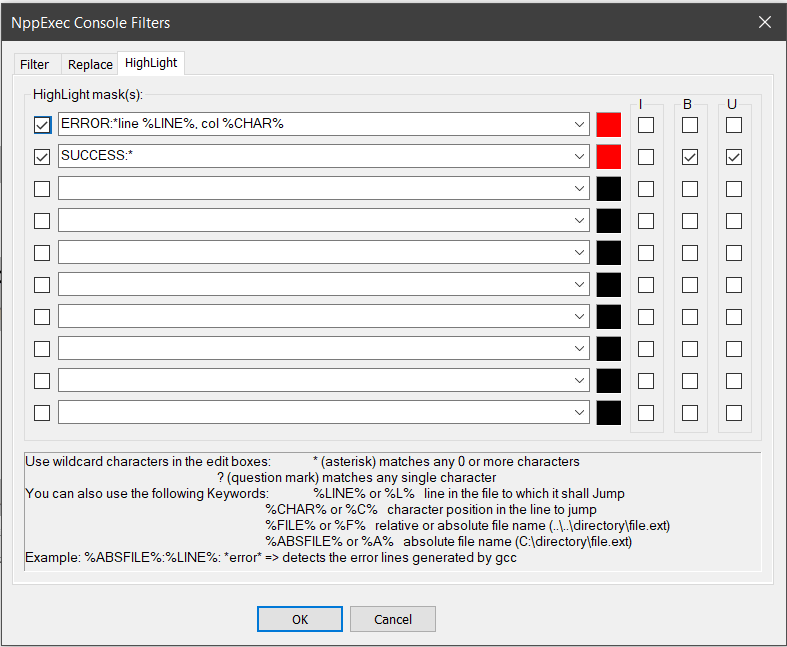
@BIGAL, I am quite sure you settled your issue in N++ a long time ago. I was facing the same situation so maybe the following will be of interest to you. I am using NppExec to Validate and Load a file to Autocad. The NPPexec either save either a Selection or the Whole active window of Notepad++ in a tempfile called "D:\Lisp\NppVal.lsp". This has to be a trusted Autocad Location. NppExec then transfer execution to a PowerShell script called ValidateAndLoad.ps1. This script is placed in directory "C:\Scripts\ValidateAndLoad.ps1" . The powershell validates the lisp and then if valid, Load it in Autocad. It then Activate the Autocad Window and brings it into view. All that need to be done is to start the command you just loaded. To Activate and bring in View, all the usual command were failing until I found a little utility called nircmd. So that is what the ps1 script uses. You will need to downlad it from https://www.nirsoft.net/utils/nircmd.html and place it in same directory "C:\Scripts" as the ps1 script. Following is the NppExec script: npp_console 1 env_set NPP_FILENAME = $(FILE_NAME) // Get selection info sci_sendmsg SCI_GETSELECTIONSTART set local pos_start = $(MSG_RESULT) sci_sendmsg SCI_GETSELECTIONEND set local pos_end = $(MSG_RESULT) sci_sendmsg SCI_LINEFROMPOSITION $(pos_start) set local start_line = $(MSG_RESULT) // Create temp file for current context if $(pos_start) == $(pos_end) then // No selection: Save whole file sci_sendmsg SCI_SELECTALL sel_saveto "D:\lisp\NppVal.lsp" sci_sendmsg SCI_SETEMPTYSELECTION $(pos_start) cmd /c powershell -NoProfile -ExecutionPolicy Bypass -File "C:\Scripts\ValidateAndLoad.ps1" -FilePath "D:\lisp\NppVal.lsp" -ScintillaLine 0 -IsSelection 0 else // Selection exists sel_saveto "D:\lisp\NppVal.lsp" cmd /c powershell -NoProfile -ExecutionPolicy Bypass -File "C:\Scripts\ValidateAndLoad.ps1" -FilePath "D:\lisp\NppVal.lsp" -ScintillaLine $(start_line) -IsSelection 1 endif env_unset NPP_FILENAME Note: NPP script does not save your file by design, when debugging I don't want to Save. Following is the ValidateAndLoad.ps1 param( [string]$FilePath, [int]$ScintillaLine = 0, [int]$IsSelection = 0 ) $ErrorActionPreference = 'Stop' $TargetDir = 'D:\lisp' $TargetFile = Join-Path $TargetDir 'NppVal.lsp' $NirCmdPath = 'C:\scripts\nircmd.exe' $MaxRetries = 10 $RetryDelayMs = 300 if (-not $FilePath) { Write-Output "ERROR: No file path provided." exit 1 } if (-not (Test-Path -LiteralPath $FilePath)) { Write-Output "ERROR: File not found: $FilePath" exit 1 } try { $enc = [System.Text.Encoding]::GetEncoding(1252) $Text = [System.IO.File]::ReadAllText($FilePath, $enc) } catch { Write-Output "ERROR: Failed to read file: $($_.Exception.Message)" exit 1 } $FileName = [System.Environment]::GetEnvironmentVariable("NPP_FILENAME") if (-not $FileName) { $FileName = "Unsaved Document" } Write-Output "VALIDATING: $FileName" $level = 0 $inString = $false $inComment = $false $inBlockComment = $false if ($IsSelection -eq 1) { $line = $ScintillaLine + 1 } else { $line = 1 } $col = 0 $bracketStack = [System.Collections.Generic.List[PSCustomObject]]::new() $expressionStack = @() $global:defunCount = 0 function New-ValidateExpression { param( [string]$ExprText, [int]$StartLine, [int]$StartCol, [boolean]$IsQuoted ) $cleanText = $ExprText -replace "\([^\(\)]*\)", " #EXPR " $cleanText = $cleanText.Replace("`r", " ").Replace("`n", " ").Trim() $tokens = $cleanText -split '\s+' | Where-Object { $_ -ne "" } if ($tokens.Count -eq 0) { return } $firstToken = ([string]$tokens).ToLower() if (-not $IsQuoted) { if ($firstToken -like '"*') { Write-Output "ERROR: First element in expression cannot be a string literal at line $StartLine, col $StartCol" exit 1 } if ($firstToken -match '^[+-]?[0-9]+(\.[0-9]+)?$') { Write-Output "ERROR: First element in expression cannot be a numeric literal at line $StartLine, col $StartCol" exit 1 } } if ($firstToken -eq "setq") { $argCount = $tokens.Count - 1 if ($argCount -eq 0) { Write-Output "ERROR: 'setq' requires at least one symbol-value pair at line $StartLine, col $StartCol" exit 1 } if ($argCount % 2 -ne 0) { Write-Output "ERROR: 'setq' has an odd number of arguments ($argCount) at line $StartLine, col $StartCol" exit 1 } } } for ($i = 0; $i -lt $Text.Length; $i++) { $c = $Text[$i] $col++ if ($c -eq "`n") { $line++ $col = 0 } if (-not $inString) { if ($inBlockComment) { if ($c -eq '|' -and $i + 1 -lt $Text.Length -and $Text[$i+1] -eq ';') { $inBlockComment = $false $i++ $col++ } continue } if ($inComment) { if ($c -eq "`n") { $inComment = $false } continue } if ($c -eq ';' -and $i + 1 -lt $Text.Length -and $Text[$i+1] -eq '|') { $inBlockComment = $true $i++ $col++ continue } if ($c -eq ';') { $inComment = $true continue } } if ($c -eq '"') { $isEscaped = $false if ($i -gt 0 -and $Text[$i-1] -eq '\') { $slashCount = 0 $k = $i - 1 while ($k -ge 0 -and $Text[$k] -eq '\') { $slashCount++ $k-- } if ($slashCount % 2 -ne 0) { $isEscaped = $true } } if ($isEscaped) { if ($expressionStack.Count -gt 0) { $expressionStack[-1] += $c } continue } $inString = -not $inString if ($expressionStack.Count -gt 0) { $expressionStack[-1] += $c } continue } if ($inString) { if ($expressionStack.Count -gt 0) { $expressionStack[-1] += $c } continue } if ($c -eq '(') { $level++ $isListQuoted = $false if ($i -gt 0 -and $Text[$i-1] -eq "'") { $isListQuoted = $true } elseif ($bracketStack.Count -gt 0) { $isListQuoted = $bracketStack[-1].IsQuoted } $bracketStack.Add([PSCustomObject]@{ Line = $line Col = $col IsQuoted = $isListQuoted }) $expressionStack += "" if (-not $isListQuoted -and $i + 10 -lt $Text.Length) { $lookAheadSlice = $Text.Substring($i + 1, 10).ToLower() if ($lookAheadSlice -match '^\s*defun(-q)?(\s|$)') { $global:defunCount++ } } if ($i + 1 -lt $Text.Length -and $Text[$i+1] -eq ')') { $isDefunArgs = $false if ($expressionStack.Count -gt 1) { $parentExpr = $expressionStack[-2].Trim().ToLower() if ($parentExpr -like "defun*" -or $parentExpr -match "(^|\s)defun(-q)?(\s|$)") { $isDefunArgs = $true } } $isQuotedList = $isListQuoted if ($i -gt 1 -and $Text[$i-1] -match '\s' -and $Text[$i-2] -eq "'") { $isQuotedList = $true } if (-not $isDefunArgs -and -not $isQuotedList) { Write-Output "ERROR: Empty parentheses () found outside of a function definition at line $line, col $col" exit 1 } } continue } if ($c -eq ')') { $level-- if ($level -lt 0) { Write-Output "ERROR: Unexpected closing parenthesis ')' at line $line, col $col" exit 1 } if ($bracketStack.Count -gt 0) { $finishedExpr = $expressionStack[-1] $lastIndex = $bracketStack.Count - 1 $currentBracket = $bracketStack[$lastIndex] $bLine = $currentBracket.Line $bCol = $currentBracket.Col $bQuoted = $currentBracket.IsQuoted New-ValidateExpression -ExprText $finishedExpr -StartLine $bLine -StartCol $bCol -IsQuoted $bQuoted $bracketStack.RemoveAt($lastIndex) if ($expressionStack.Count -gt 1) { $expressionStack = $expressionStack[0..($expressionStack.Count - 2)] $expressionStack[-1] += " #EXPR " } else { $expressionStack = @() } } continue } if ($expressionStack.Count -gt 0) { $expressionStack[-1] += $c } } if ($level -gt 0) { $lastOpen = $bracketStack[-1] Write-Output "ERROR: Unclosed parenthesis '(' starting at line $($lastOpen.Line), col $($lastOpen.Col)" exit 1 } Write-Output "SUCCESS: Validated $global:defunCount function(s) successfully." if (-not (Test-Path -LiteralPath $TargetDir)) { New-Item -ItemType Directory -Path $TargetDir -Force | Out-Null } try { $enc = [System.Text.Encoding]::GetEncoding(1252) [System.IO.File]::WriteAllText($TargetFile, $Text, $enc) } catch { Write-Output "ERROR: Failed to write $TargetFile : $($_.Exception.Message)" exit 2 } if (Test-Path -LiteralPath $NirCmdPath) { try { Start-Process -FilePath $NirCmdPath -ArgumentList 'win activate stitle AutoCAD' -WindowStyle Hidden | Out-Null Start-Sleep -Milliseconds 500 } catch { } } $acad = $null for ($i = 1; $i -le $MaxRetries; $i++) { try { $acad = [Runtime.InteropServices.Marshal]::GetActiveObject('AutoCAD.Application') if ($acad) { break } } catch { Start-Sleep -Milliseconds $RetryDelayMs } } if (-not $acad) { Write-Output "ERROR: Could not attach to a running AutoCAD instance." exit 4 } try { $safePath = $TargetFile.Replace('\', '\\') $acad.ActiveDocument.SendCommand("(load `"$safePath`")`n") Write-Output "SUCCESS: Loaded $TargetFile" exit 0 } catch { Write-Output "ERROR: Failed to send load command to AutoCAD: $($_.Exception.Message)" exit 5 } Notes: Autocad has to running and a drawing open in order to load. If validation fails you are dumprd back to N++ with the NppExec console showing you where it fails. If you double click on the error line you cursor in N++ will go to that line. Bear in mind that the error location is not perfect, but you are normally in the right function. Finally to get the error lines and Success lines to appear in red, you have to set the NppExec Console Filters as shown in the below image. Phew!! that was a long post. ymg
-
 JuanM joined the community
 -

A CODE FOR DIVIDING OBJECTS WITH POINTS AS IN MEASURE AND DIVIDE COMMAND IN AUTOCAD BUT WAY MORE ADVANCED
mhupp replied to darshjalal's topic in AutoLISP, Visual LISP & DCL
if Nothing else it would show up in peoples searches. just posting a file even tho it has great documentation will not show up in searches. if you take all the time to write things up and share here make it so people can find your lisp files. or just copy all the ;; lines. someone in 6 months to a year will post looking for a divide lisp with points and I won't be able to find this post. -Edit like you did here -

A CODE FOR DIVIDING OBJECTS WITH POINTS AS IN MEASURE AND DIVIDE COMMAND IN AUTOCAD BUT WAY MORE ADVANCED
pkenewell replied to darshjalal's topic in AutoLISP, Visual LISP & DCL
@darshjalal Thanks for your program contribution. I don't want to take away for your obvious hard work, but I somewhat agree with @BIGAL. I have read the extensive comments that are very detailed and technical, but there is no summary of what it is used for, or how it is useful. For the casual LISP user, they would not understand the value in such a program. I think a simple paragraph would be help instead of blindly evaluating it. Your title does explain the purpose of the program, but it's too vague and some plain language on how the features are helpful would be nice - just a friendly critique -
@Danielm103 Why Properties palette doesn't show how many vertices does closed polyline have? That was always included AFAIK if I can recall correctly...
-
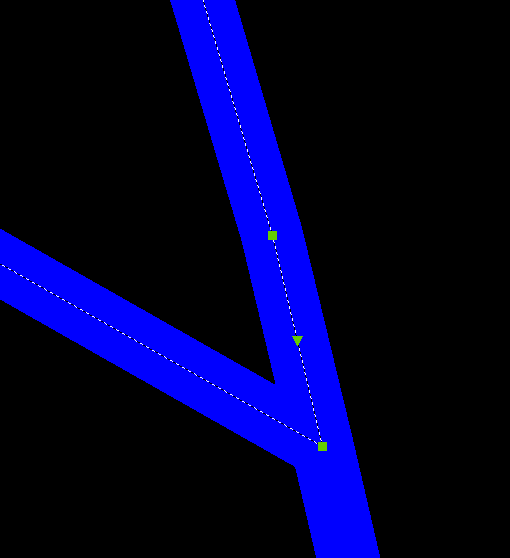
creates a closed polyline in Autocad 2027
-
Does it create a closed poly? or is it open where the two lines don't meet.
-

Unexpected behaviour handling multiline attribute when inserting block with Lisp
Nikon replied to Mr Whippy's topic in AutoLISP, Visual LISP & DCL
Why the error occurs The PAUSE limitation: In AutoLISP, pause only stops the command to let the user interact (e.g., click a point). It does not return the string value to the command sequence. When you reach the attribute part, AutoCAD expects a string, but since pause doesn't provide one, the sequence breaks.Multiline Attribute Format: Multiline attributes in a command-line sequence require specific formatting. If there are line breaks, they must be represented by \P. In Lisp, you must escape the backslash: \\P .Command vs -Command: When using Lisp, it is safer to use the hyphenated version (e.g., -INSERT ) to force the command-line interface and bypass dialog boxes entirely. The Corrected Lisp Routine This routine replaces your DIESEL script. It captures the date automatically (matching your DIESEL format) and prompts for the initials and notes. (defun c:REVNOTE (/ insPt dateStr userInitials revNote) ;; Save current ATTDIA and turn it off (setq oldAttdia (getvar "ATTDIA")) (setvar "ATTDIA" 0) ;; 1. Get Insertion Point (setq insPt (getpoint "\nSpecify insertion point: ")) ;; 2. Get Date (Mimicking your Diesel formatting) ;; This uses a Lisp trick to call the Diesel 'edtime' function directly (setq dateStr (menucmd "M=(edtime,$(getvar,date),DD.MO.YYYY)")) ;; 3. Get User Initials (getstring T allows spaces) (setq userInitials (getstring T "\nEnter Initials: ")) ;; 4. Get Revision Note (for the multiline attribute) (setq revNote (getstring T "\nEnter Revision Note: ")) ;; 5. Execute the Insert command ;; Sequence: BlockName, Point, ScaleX, ScaleY, Rotation, Attr1, Attr2, Attr3, Attr4 (command "-INSERT" "REVNOTE" ; Block name insPt ; User picked point "1" "1" "0" ; Scale and Rotation "P01" ; Attribute 1: Rev Index dateStr ; Attribute 2: Date userInitials ; Attribute 3: Initials revNote ; Attribute 4: Multiline Note ) ;; Restore ATTDIA and Regen (setvar "ATTDIA" oldAttdia) (command "REGEN") (princ "\nRevision inserted successfully.") (princ) ) Key Differences & Improvements: menucmd: This is the best way to get the exact edtime format you used in DIESEL without writing a complex date-parsing routine in Lisp. getstring T: The T flag allows the user to enter spaces (e.g., if the user wants to type "First issue - revised"). Without it, pressing the Spacebar would finish the command. -INSERT: Using the hyphen ensures that AutoCAD doesn't try to pop up a browser window for the block file.Multiline Support: If your revNote contains multiple lines, make sure to type \P where you want the line break, or modify the code to join multiple strings with \\P. -
 TALWAR joined the community
 -
It seems @Jesper Hedlund hasn't returned. If I am understanding correctly, the issue is with the program used to plot the layouts, it plots Model instead of the actual layouts CTAB value.
-
 AbdelrhmanElkholy joined the community
 -
Worked fine on my home computer with AutoCAD 2000i, but I get the same as @PGia and @ronjonp on AutoCAD 2026 at work.
-

A CODE FOR DIVIDING OBJECTS WITH POINTS AS IN MEASURE AND DIVIDE COMMAND IN AUTOCAD BUT WAY MORE ADVANCED
darshjalal replied to darshjalal's topic in AutoLISP, Visual LISP & DCL
Inside the code there is explanation of the code function. The code does many functions that image can't explain. Kindly check the code and read the description inside. Regards. -
 bayhan joined the community
 -
A CODE FOR DIVIDING OBJECTS WITH POINTS AS IN MEASURE AND DIVIDE COMMAND IN AUTOCAD BUT WAY MORE ADVANCED
BIGAL replied to darshjalal's topic in AutoLISP, Visual LISP & DCL
If your offering something a good idea is to provide images or a movie about what the program does, else the "Why bother" will occur. Just attaching a lisp is not really describing why you should download the program. Think of it as if I was selling the program how would I get people interested. -
 SPk22991 joined the community
 -
DIVCURVES-INSERTING POINTS AS SPECIFIC DISTANCE.LSP I am so sorry for not giving more details about the code. Please read the following for more details: When executed, the utility launches an interactive keyword configuration: Menu: [1-Polylines/2-Lines/3-Arcs/4-Circles/5-Splines/6-FeatureLines/7-All] --- OPTION 1: Polylines --- - Target: Native 2D LWPolylines and 3D Heavy Polylines (*POLYLINE). - Sub-Prompts: Asks for both "Curve distance" and "Line distance". - Workflow Logic: Polylines frequently alternate between straight tangents and arced bulges. The engine runs through each sub-segment parameter, applying the Curve interval on loops returning a non-zero bulge and the Line interval on zero-bulge vectors. Critical for tracking centerlines. --- OPTION 2: Lines --- - Target: Standalone native LINE entities (completely ignores curves). - Sub-Prompts: Triggers only "Line distance [Middle/Vertices]". - Workflow Logic: * Absolute Number: Measures out fixed structural intervals from start. * "Middle": Drops a single layout node at exactly Total Length / 2. * "Vertices": Flags only the absolute start and endpoints, bypassing any segment division calculations. Perfect for boundary box indexing. --- OPTION 3: Arcs --- - Target: Standalone open circular ARC elements. - Sub-Prompts: Triggers only "Curve distance [Middle]". - Workflow Logic: Uses true structural arc-length path calculations (not straight-line chord spacing). Entering "Middle" isolates the exact apex mid-curve station node. Excellent for curb returns or radius layout. --- OPTION 4: Circles --- - Target: Full, closed 360-degree CIRCLE elements. - Sub-Prompts: 1. Circle Mode [Distance/Pieces] 2. Curve Distance (if Distance Mode) 3. Number of Slices (if Pieces Mode) - Workflow Logic: * Pieces Mode: Divides the 360° rim into perfectly equal pie sections. Ideal for setting layout coordinates for manholes or foundation piles. * Distance Mode: Steps linearly around the outer circumference. --- OPTION 5: Splines --- - Target: Non-uniform smooth organic SPLINE curve strings. - Sub-Prompts: Triggers "Curve distance" and "Line distance". - Workflow Logic: Utilizes Visual LISP curve projection vectors to step smoothly through changing multi-radius landscape or contour paths, automatically trapping and marking the true start/end index boundaries. --- OPTION 6: FeatureLines --- - Target: Native Autodesk Civil 3D Feature Lines (AECC_FEATURE_LINE). - Sub-Prompts: Triggers "Curve distance" and "Line distance". - Workflow Logic: Tailored for civil infrastructure models. The engine interrogates the 3D string, locks all critical grade breaks and site vertices, and overlays intermediate interval layout points that retain design model accuracy. --- OPTION 7: All --- - Target: Simultaneous mixed selection set of all supported geometries. - Sub-Prompts: Sequential configuration parameters for all curves/lines. - Workflow Logic: Scans the entire cross-window selection. For every object trapped, it reads its DXF Group 0 type, dynamically assigns your preset rules, avoids duplicate coordinate overlaps, and populates the entire site plan layer in a single execution click. SHORT SEGMENT OVERRIDE LOGIC: If an entity length or sub-segment is shorter than the interval distance specified, the script halts and prompts: [Middle/All/SkipAll] - "Middle": Drops a layout node exactly at the center of that specific short segment. - "All": Converts the current short vector and all subsequent short vectors discovered during the current command run into midpoints automatically. - "SkipAll": Ignores short segments entirely for the rest of the execution, leaving them clean and checking only major length spans. SHORT SEGMENT OVERRIDE LOGIC: If an entity length or sub-segment is shorter than the interval distance specified, the script halts and prompts: [Middle/All/SkipAll] - "Middle": Drops a layout node exactly at the center of that specific short segment. - "All": Converts the current short vector and all subsequent short vectors discovered during the current command run into midpoints automatically. - "SkipAll": Ignores short segments entirely for the rest of the execution, leaving them clean and checking only major length spans.